Chapters 3 and 4
Chapter 3
Return
Impervious to the ravages of human malevolence, the seasons marched through their inevitable course. The hot afternoons of late summer gave way to early evenings and cool breezes buoying colorful fall leaves, the kind of weather that spurs physical activity. Taking a cue from his host across the channel, Gerhardt began riding his bicycle everywhere, as much to reacquaint himself with the scarred landscape as to exercise his legs. His ride on this Montag morning took him a brisk fifty kilometers into the capital city. He considered the fact that technology had not yet wrought a means of destruction so great as to disfigure the land, sea, and sky beyond their intrinsic ability to heal, but he wondered how long it would be before humanity could bring about its own demise. Several heads turned on his passage as he rolled through the University campus to the Center for Design and Engineering, dismounting and leaving his bicycle leaned up against a heap of others outside the School of Architecture.
He took the side entrance, bounding up two flights of stairs, and half skipping around the hallway. His movements elicited a sound like muted sleigh bells. The chain made a soft thud against his collarbones on each step, and he knew he could never sneak up on anyone like that. His limp had become subtler since his return and if he concentrated, he could make it mostly disappear. Who knew if his old professor’s office was where it used to be, or if the man even still taught at the University, but Gerhardt reasoned that he would have a much better chance of continuing where he left off if he had an advocate within the system. He found the office door partially closed and paused before knocking when he heard animated bits of conversation. One of the voices he recognized was that of his professor.
“Well, before you make any more opinionated statements on the matter, that happens to be one of my former students.”
“What a complete, arrogant ass! A real credit to your department. I’d be careful advertising that fact if I were you.”
University politics… maybe now is not the best time to stop by. Gerhardt took a step back when the other participant in the conversation threw the door open and strode out of the office. Gerhard recognized him as the dean of the philosophy department. The man blinked back his surprise, wholly caught off guard by the presence of another person in the hallway. The philosophy dean narrowed his eyes in what looked like revulsion and cursed under his breath, quickening his pace as he walked away, probably embarrassed that his outburst had been overheard.
What’s with him? Gerhardt stood just outside the now open doorway. “Herr Bauhauer…?” A grey-haired professor looked up from his desk. Last time Gerhardt has seen the man, his hair had been mostly black. “I don’t know if you remember, but I was a student of yours…”
“Gerhardt Bosch,” the professor seemed just as surprised as the philosophy chair. “Speak of the devil. Of course, I remember you; you were a promising student before you became the, uh… infamous flying ace. Come in, come in,” he motioned with his hand to his former pupil. “I was sorry to see you leave the University. We lost so much potential during that war.”
Gerhardt couldn’t help but notice that the issue of ‘Vive!’ featuring him on the cover sat on the edge of Professor Bauhauer’s desk. “I hate that picture,” he said reflexively on seeing it again. It was one thing to be portrayed that way by a vindictive adversary, but Gerhardt liked his former professor and was mortified that Bauhauer kept a copy of the image in plain sight.
“Yes, the gentleman whom you may have seen leaving and I were just discussing that.” He nodded towards the magazine. “Unfortunate you had to endure that, but not surprising considering your… particular aptitude, that they would make such an example of you.”
“I didn’t mean to be listening in, but that’s what that was all about?”
Bauhauer tilted his head in the affirmative. “I’m sorry you had to hear it, then.”
As a student, Gerhardt had idolized his professor, who now seemed to have his reservations when speaking with him. He wondered what that meant for his chances of finishing his studies. “Probably a little naïve of me to think coming back here wouldn’t stir up some kind of controversy.”
“Well, it’s hard to be witness to what’s happened to you,” he tilted his head again towards the picture, “and I’m not just talking about that.” Gerhardt shrugged, not exactly sure what his professor meant. He resented the metallic chime that accompanied his gesture, being reminded that he would always bear the yoke of that ignominy. Bauhauer continued, “I remember you as being so young and enthusiastic when you first came to the program, but this war has destroyed your innocence. I would not have imagined you being capable of some of the things you have done, and truthfully, I was surprised by it.”
“I wouldn’t have imagined it either, but… I’d really rather not talk about it.” Nobody’s reaction to me so far has been particularly encouraging.
“Of course. Well, at least you’re alive and back in one piece.”
The professor’s comment made Gerhardt recall his X-ray images. It could have been worse. He felt suddenly appreciative of the fact he had just ridden 50 kilometers on a bicycle and seemed to be recovering his health quickly.
“In a way, that photograph rallied the entire nation behind you,” Bauhauer said, putting the magazine away in his desk drawer. “Some viewed the way you carried yourself as a mark of professionalism, others saw it as extraordinary arrogance, but it did give a lot of people hope in the face of insurmountable defeat.”
How did you see it? Gerhardt’s question went unasked. “It was never my ambition to be a martyr.”
“For a while, you were standing on the highest pinnacle, but history shows that rarely lasts long before the precipitous fall. Judging from the article, however, even your greatest enemies hold you in high esteem.” Gerhardt couldn’t see the event as cause for commemoration. No matter how anyone else perceived it, he was the one who had to live through it and was just glad to have kept his composure through the ordeal. “Who knows,” the professor continued, “if you hadn’t been shot down, you might have been content to rest on your laurels as the top scoring ace of the war and live out the rest of your life in complacency; either that, or stayed in the flying corps, and frankly, that would have been a waste of your talents.”
“That’s what I wanted to talk about. I would like to re-matriculate.”
The professor tilted his head in the affirmative. “I assumed that’s why you’re here. Honestly, I’m glad you came back, and I think I speak for the entire department when I say we would be happy to have you…”
Before the war, Gerhardt had been any other student, but on his return, he found himself constantly having to downplay his instant recognizability. He tried to carry on normally, but most of the students, and even members of the faculty seemed to view him with a mixture of curiosity and reverent awe. Fortunately, he rarely saw the philosophy chair except at large formal functions, and if they happen to pass each other on campus, the professor made no overt acknowledgement of him. As days grew shorter and the temperatures plummeted, Gerhardt found that the heavy chain rapidly drew off his body heat to the point he would shiver unless he kept it well insulated, necessitating that he wore some sort of scarf through most of the winter.
By the close of winter semester, post-war fervor had calmed somewhat, and Gerhardt had so immersed himself in his studies that he managed to put the war behind him, coming to view it simply as an unwelcome intrusion into his life. It had, however, left its permanent marks on him. His leg ached every time the weather became cold or damp, aggravating the limp that had otherwise mostly disappeared, and he still wheezed for breath in extreme cold or during high exertion. Occasionally, dreams rousted him from his sleep, coating him in an icy sweat, but it was nice to wake up in the morning and not have to confront the chance of being shot out of the sky. To survive that once was enough. The chain became another one of those persistent burdens like an old injury, at times making its presence acutely felt.
Picking back up his old habits and resuming the mundane tasks of everyday life helped him get back into his pre-war stride. Having inveigled one of the art professors to allow him to use the pottery studio, he began making his own tableware again. In spite of a mild, nagging cough that plagued him through that winter, he spent endless hours when he wasn’t studying, cross-country skiing on the trails in the nearby wooded parks. Rarely did anyone allude to what happened to him at the end of the war, and he was perfectly content not to call attention to it. He abstained from wearing war decorations in public – a practice common among service members – even on Veteran’s day, which preceded the solstice and the Great Birthday of our Lord by a few days. “The great flying ace” instead chose to celebrate the season at home, appreciating the fact that the black veil that hung over the winter holidays lifted for the first time in seven years. During the war, such festivities remained a subdued affair, becoming as much a reminder of who was missing as it was about giving and receiving.
Once the weather warmed enough for the snows to clear, Gerhardt pulled out his old bicycle and completely rebuilt it, so well in fact that one of the local shop owners offered him a part-time job whenever he needed the extra money. Working in the back of the shop one afternoon, he eavesdropped on a conversation between the shop owner and a customer. Gerhardt caught the interaction out of the corner of his eye, including the man peering curiously across the counter. The customer asked in a low tone, “…is that… who I think it is?”
The owner was a little harder to hear since his back was to him, but as best Gerhardt could make out, he said, “yes, it is, and you know? He’s got to be the best mechanic I’ve ever hired, and one of the most practical, down-to-earth young men you could ever meet.”
Gerhardt smiled but tried not to give any indication he overheard them. It comforted him that most seemed to accept him without judgement. He also took pride in his ability to keep something running efficiently, extending its usable service life as long as possible. Perhaps that same assiduousness had allowed him to survive the war, but even his best measures hadn’t been able to prevent the inevitable…
Flashforward
…at first, it had been the sputtering of his failing engine, then his wingman pulling away inexplicably, followed by the sensation of plummeting from the sky, spinning… this time he was in a flat spin upside-down. Somehow, it had suddenly become night. Dietrich was standing on the undercarriage of his aircraft glaring down at him. Pinpoint specs of stars twirled into circular patterns at the edge of his vision…
Next, he found himself enveloped in darkness, cold and unforgiving. He couldn’t see, but he could sense the remote outline of a world he could no longer touch. Though he reached out for it desperately, a spaceless void surrounded him, imprisoning his disembodied soul and saturating him with unspeakable anguish. He couldn’t move; he couldn’t do anything. In the distance, life went on without him.
He awoke with a start, panting for breath… Cold, shimmering sweat covered him. It took him a minute to convince himself he was in his student apartment near the university when he finally sat up. Because the war had claimed so much of his youth, he attended summer sessions to make up for lost time, and he did not want to be late for class. The dream so unsettled him he took a while to regain his bearings. Once dressed, he gathered his notebooks and portfolios and rode to campus without eating breakfast. Despite his efforts, he ended up making a clumsy entrance several minutes after the morning lecture started. Everything seemed out of place, and he feared others might think he was intoxicated. By late morning, he had yet to find his normal rhythm, so he took time between classes to grab some coffee at one of the University’s popular hangouts, debating with himself whether to attend his afternoon lecture or go home.
“Hey, Gerhardt,” one of his fellow students called to him as soon as he saw him. “Have you read the paper today?”
“No...”
“You… indirectly made the front page.”
Oh..., why would I be… Then it occurred to him, this was the anniversary of the day he had been shot down. No wonder I was having such bad dreams. “Nope, haven’t seen it.” …and I don’t think I want to, either.
“You might want to take a look.” His colleague casually passed the paper towards him. The headline read: ‘Francinia Declares National Holiday.’ A sickening feeling sunk into Gerhardt’s stomach as he read how Francinia’s parliament inaugurated ‘Air Victory Day’ in celebration of his being shot down. The accompanying picture depicted a group of Allied military aviators smiling as they popped the cork off a champagne bottle. Though he said nothing as he read to the bottom of the page, he made no attempt to hide his disgust as he tossed the paper aside and silently stormed out.
Attempts to take notes during the next lecture were in vain; he spent most of the time sitting in the back of the hall fidgeting with his pen and doodling angry motifs in his notebook. Herr Bauhauer caught him just as he was leaving. “Gerhardt, if you have time, I’d like to see you in my office.”
“Yes, sir?” Gerhardt said as soon as the professor closed the door.
Bauhauer crossed his arms on his chest and tilted his head at him. “I assume your lack of engagement in class today was a reaction to today’s front-page story in the paper.”
“Was it that obvious?”
Bauhauer laughed. “Your agitation was keenly felt.”
“I’m sorry…” His apology hung awkwardly in the ensuing silence before he added, “maybe I should have skipped class today.”
“Would you like to talk about it?”
The question bewildered him at first, but his professor’s invitation brought forth the internal deluge before he could shut it off. “You know, I never had it out for anyone; I wasn’t holding grudges, I was doing my job and trying to survive just like everyone else in that war – a war I never wanted any part of to begin with – but now they’ve turned it into some kind of personal vendetta. You’d think they would have been satisfied after they exacted their retribution, but they just won’t let it go. They have to keep sticking it in my face, and now they’re practically blaming me for losing the war!” Gerhardt almost never raised his voice and his outburst surprised even him. The idea of creating a national holiday in honor of his being shot down made him as sick as when the Allied Powers forced him to sign that agreement.
Bauhauer gave a conciliatory nod. “Occupational hazard. You become the most successful flying ace – and you have to admit, you had quite a bit of publicity surrounding you – your enemies are going to want to bring you down, and when they do, they’re not going to be gracious about it.”
“It’d be one thing if I were dead, but… hell… I don’t know… why am I even still alive? It’s not like I’ll ever be able to get out from under their yoke.”
“Perhaps instead of being offended, you should be flattered. They obviously perceived you as a great threat if they felt they had to make you, personally, sign a covenant of nonaggression, and if they celebrate the day you were shot down as ‘Air Victory Day’ – well, the name says it all.”
“There are times when I wonder if I were responsible for losing the war…”
“The day you were shot down was a tremendous loss for Richtenstadt, but one person does not win or lose a war by himself. Don’t make the same conceited mistake Teluricus did.”
“What if I had broken the blockade? What if I hadn’t been shot down?”
“Those are scenarios that can never be tested so there’s no use worrying about them now.”
“Maybe I would have been better off dead.”
“Well… you have spoken to me, several times – quite enthusiastically – about your vision. From what you’ve shown me, I believe it is well within your power to realize it, but it will be a life-long undertaking. If you give up now, it can never happen. Please… don’t deprive the rest of us of that vision.”
Gerhardt cast his head down sullenly. “Who’s going to care?”
“Gerhardt… Head up.” Only when Gerhardt looked up at him did the professor speak again. “I suppose it all depends on how you want to be remembered. Do you want to be the one who took the defeat of an entire nation upon himself, or do you want to be the one who rebuilt that nation?”
“There’s no guarantee I can do that.”
“There’s no guarantee of anything, except that you can’t, if you’re not around to do it.”
Gerhardt cogitated on this for several moments before releasing a deep breath. “I guess you’re right.”
Close Call
On the way home, Gerhardt tried to reframe his take on the situation. His thoughts so engrossed him that he didn’t notice the stop sign at the four-way intersection…
…nor did the person driving the car across the perpendicular road.
Both of them swerved and slammed on the brakes at the last possible second. Gerhardt had to throw his weight back off the seat to keep from going over the handlebars. The contrecoup of his chain caught him hard on his collarbones. The edge of the car’s front bumper ended up a few centimeters from Gerhardt’s left leg.
“Damn,” Gerhardt muttered, realizing how close he had just come to dying… again, and he certainly couldn’t afford to break that leg again. His gaze met the other person’s but he harbored no resentment. He realized they had both equally been at fault. He shook his head at himself for his carelessness.
The driver leaned out the window. “Hey, you all right?”
“I’m fine, and you?”
“I’m not the one to worry about.” He got out of the car and offered his hand. “Herr Bosch – wow – I’m really sorry I almost ran you over, but you need to be more careful too! We both ran that sign!”
“Ja, I know. I was distracted.”
“After what you went through because of that war, you do not need to get killed now in some stupid traffic accident!”
Gerhardt mused, “would be ironic.” The appreciation of life’s fragility came upon him again, as it had many times during the conflict.
“I wouldn’t have been able to live with myself if I had killed the greatest flying ace of all times, even if it was only half my fault …and on the same day you got shot down too!”
“Great flying aces don’t get shot down.” They probably don’t run stop signs either.
“Hell, what are you talking about, man? You almost won the war for us! Even those Francinian idiots acknowledge that.” The driver sauntered back to his car. “Listen, glad you’re all right. Be more careful – I certainly will be. Something tells me we haven’t seen the last of you yet.”
Gerhardt smiled faintly as he gave a nod, then rode cautiously the rest of the way home. There must be a reason I’m still alive. The vision he had in Francinia of the bridge, and then during the trip home of the skyline reappeared in his mind. I had better take the opportunity while I still have it.
Chapter 4
Return of the White Fox
“Dietrich von Strieben?” It took Gerhardt a few moments to resolve the image of the man who leaned in his doorway. DS, as everyone in the unit called him for the way he signed his reports, had always been a thin man, but he seemed to have lost even more weight since the war.
“Graf von Strieben,” Dietrich replied.
“Oh… sorry to hear that.” When Gerhardt had known him, Dietrich had still been Erbgraf, or hereditary Count. “I mean, I’m sorry about your father.” In Gerhardt’s view, Dietrich could have been a handsome man if he had better looked after his appearance. His features recalled those of ancient statues, but now, the aristocrat flying ace’s cheeks had drawn taut and faint rings of purple circled under slightly bloodshot eyes. Dietrich’s tow-blonde hair, that had been close-cut during regular military service, now grew out in unrestrained tufts. Gerhardt could see why Francinian newspapers dubbed him ‘the White Fox,’ once he took over the air wing. “Well, Graf von Strieben, I haven’t seen you in…” since you abandoned me, Gerhardt buried his resentment, knowing that Dietrich’s decision had probably been in the best interest of the unit, “almost four years.” DS entered the office and closed the door quietly as Gerhardt stood up from behind a drafting table next to a heavy, old wooden desk.
Dietrich seemed to absorb the surroundings of Gerhardt’s small office. Early afternoon light bathed the room from the single southwesterly-facing window, illuminating a few lithographs featuring famous technical studies of ancient landmarks and a poster that read, ‘Call for Submissions: Resolution Plaza Design Contest.’ The submission date had long since passed and the poster already started to come un-tacked from the wall at one corner.
“I wouldn’t have thought you would take a job at an architecture firm. Seems a bit academic for someone like you. What have they got you doing?”
“I’m apprenticing.”
“Apprenticing in what?”
“Architectural design and structural engineering.”
“Oh, so you went back to school,” Dietrich observed offhandedly. “Did you finish some sort of degree?”
“Architectural design and structural engineering.”
“What made you choose that?”
“That’s what I was doing before the war.” Gerhardt was a little surprised his colleague hadn’t known that.
“Hmmm,” Dietrich twitched his mouth. “Well, I guess that explains your bizarre paint scheme, then… and your crazy wing struts.” His whole demeanor changed suddenly. “Listen Ger,” he began softly. “I have a bit of a favor to ask.”
“What can I do for you?”
“I’m afraid I’ve fallen into hard times. I need to borrow some money.”
Dietrich’s custom-tailored, silk-wool blend suit and precision aviation watch didn’t mesh with Gerhardt’s impression of a man in need of money. The Cross of War substituted for a tie, as wearing one’s war decorations remained a trend.
“How much?”
“Ten thousand Kroner.”
“Are you kidding me?” Gerhardt spat out. “I don’t have that kind of money lying around, and I doubt I even have that much liquid in the bank right now.”
“Anything you can float me would help. Even if I take out a secured loan and you cosigned for it…”
Gerhardt shrugged at his colleague’s lack of logic. “I don’t have the collateral you would need for that, and besides, you can’t just borrow more money against borrowed money.”
“I didn’t borrow the money to begin with.” DS half deflated. “It’s… the estate ran out. After the war, I came home to find years of back taxes that accumulated, huge penalties, outrageous interest… all kinds of financial matters that didn’t get attended to in my absence, and the livestock all got sold because no one was around to take care of it. That left me with no collateral.”
Of all the members of his unit, Dietrich was by far the most affluent. Gerhardt had been to the von Strieben estate once when the family hosted a dinner for the air wing in the thirty–something-room stone mansion that presided over several hundred acres of rich farmland. The estate sprawled across the foothills of the Valhalla Range right where the mountains rose up to the heavens. The estate certainly looked well-maintained then. While Gerhardt enjoyed the basic creature comforts growing up, his family’s holdings were nothing approaching aristocracy.
DS explained, “I just need to buy some time until I can collect some return on my investments.”
“I have to be forthright with you,” Gerhardt said, “I can’t invest in anything that involves manufacturing for martial enterprise, even indirectly. The contract I signed was quite specific about that.”
“Well, did it elaborate on what the hell that means exactly?”
“I guess that would include munitions, military shipbuilding and aviation, certain heavy equipment, steel, you know… that kind of thing.”
“Damn, you could interpret that to mean just about everything. Well, you don’t have to worry about violating your agreement. I just need to pay off the estate taxes.”
“Considering what you invest in, there could be some constraints on how you paid me back.”
“I can pay you in land, how about that?”
Gerhardt thought about it for a minute. “That might work. What time frame are we talking about here?”
“A year, maybe? Listen, I wouldn’t ask if this weren’t important; you know that. I might be able to sell off some of the estate’s land, but that takes time, and with the economy the way it is, the market isn’t great right now.”
“I understand but give me some time to think about it. I can’t promise anything.”
“All right. Think about it and check with your bank to see what you have that you might be able to lend me. How about I come back Donnerstag around lunch? You think you can have an answer by then?”
Gerhardt’s sigh bordered on exasperation, but he finally acquiesced. “I’ll try.”
“Thank you, this means sooo much to me…” Dietrich disappeared almost as soon as he had spoken.
A few moments later it was Gerhardt’s boss who darkened his door. “Was that one of your war buddies?”
“Yes, Sir. He wants to stop by Donnerstag around lunch so I can help him with something. Would it be all right for me to take an extra hour or two out of the office?”
“I don’t see why not.” His boss crossed his arms, then tilted his head with an unreadable sort of look. “…but I have a bit of news for you…” he nodded at his apprentice, “you might want to sit down first.”
Gerhardt slipped into the chair behind his desk. “Yes, Sir?”
“I received quite an interesting letter from the committee judging the Resolution submissions. All the members agreed that your design is unlike anything any of them had seen before. They even go so far as to declare that it establishes a new architectural genre.”
“I hope that means they liked it.”
“You won, Gerhardt – you’re going to build the new plaza…”
The Silver Phantom
For the next several days, the office resounded with giddy excitement of having landed the contract for rebuilding the centerpiece of the capital, the city’s main public square. Donnerstag rolled around, and Gerhardt’s former wingman arrived amidst an animated discussion between Gerhardt and some of his mentors about logistics and the timeframe for the project.
“Tag,” Dietrich said, disrupting the affair by barging into Gerhardt’s office without asking permission to enter.
“Guten Tag, Dietrich… Endschuldigung, Graf von Strieben,” Gerhardt responded, looking up from what he was doing long enough to acknowledge his visitor, hoping he would take the hint and wait outside until they were done.
“You didn’t forget our appointment, did you?”
“No, I haven’t forgotten, but you’ve caught me right in the middle of something.”
“You go on Gerhardt,” his boss said, “we’ll resume this when you get back.”
“Yes Sir,” he nodded, then wedged himself between his desk and drafting table to join his flying compatriot who waited for him at the door. Once down the hall Gerhardt said, “I was in an important meeting. I would have appreciated if you had waited until we had finished.”
Dietrich shrugged, “you looked like you were pretty involved in something. I didn’t know how long it was going to take, and I have a lot of other errands to do.” On the elevator ride, DS commented, “did you ride a bike?”
“Ja.” To accommodate the large post-war population of commuter cyclists, clothiers began manufacturing well-tailored suits with double-vented, double gusset-back jackets and tapered double-seated knickers worn with long socks or stockings that wouldn’t get caught in a bicycle chain and would allow for greater freedom of movement. The Graf raised an eyebrow at Gerhardt who glanced down at his dark gray pedal pusher. “It’s functional,” Gerhardt responded to Dietrich’s unspoken criticism; he thought the styling fit him rather well.
“What, you don’t have a car?” The elevator let them off in the lobby.
“I live close enough I don’t need one, and I can always take the bus if the weather gets bad.”
“Hmmm.” Dietrich’s expensive suit seemed quite in contrast to Gerhardt’s utilitarian wear. Instead of his war medal, he wore a mint-green tie tacked down with a white gold or platinum bar. Gerhardt recalled that his colleague had a fancy tea service in that light-green shade, and towards the end of the war, Dietrich had painted a diagonal flash on the fuselage and the tail of his aircraft in the same color.
“Whoa! What is that!?” Gerhardt stopped short as they went outside. Dietrich trotted up to the driver’s side and opened the door to the most expensive vehicle ever manufactured.
“It’s the Silver Phantom, all hand-built by Mazeppa Motorenbau and numbered. This one is the forty-seventh off the production line.”
“That’s gotta be worth a fifty-k, at least. Why don’t you just sell the car?” Gerhardt said before getting in.
“It’s not mine,” Dietrich explained as he started the engine, which sounded more finely tuned than any other – belonging to a car or aircraft – that Gerhardt had ever heard.
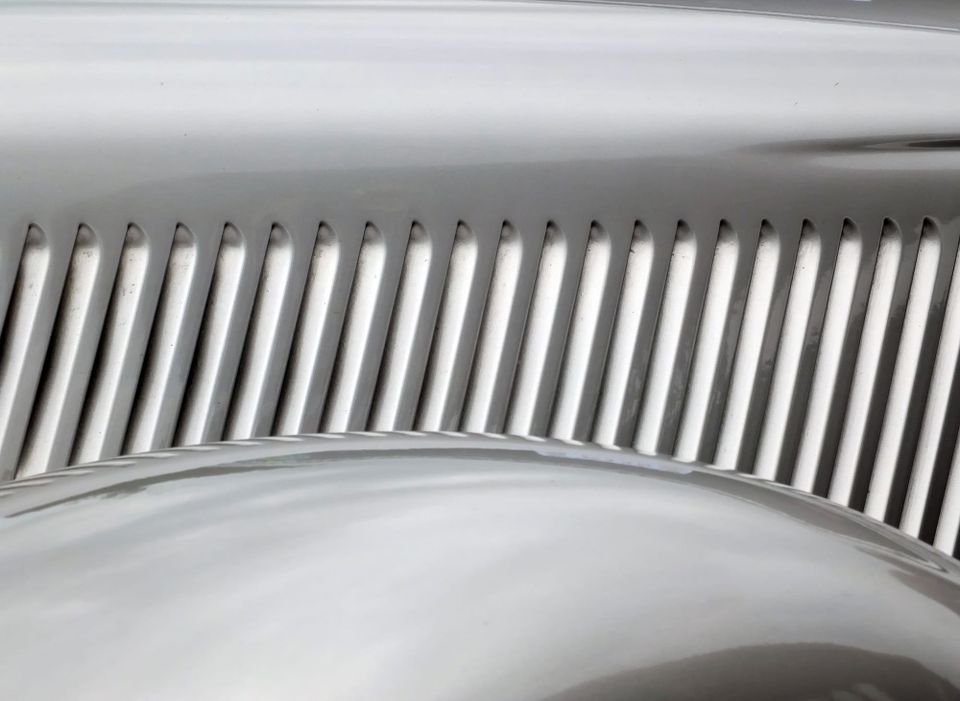
“It’s my uncle’s.” The interior was relatively quiet – quiet enough to carry on a conversation at normal volume. The car’s two-tone gray and black interior, featuring perforated leather seats and a hint of chrome in the dashboard trim seemed tastefully appointed to Gerhardt – a subdued kind of elegance and the kind of detail that an architect would appreciate.
“It was a gift from Georgy Mazeppa himself who did, and still does, a lot of business with my uncle, so it’s not like we can just turn around and sell it.”
Gerhardt figured maybe Dietrich had sold his own car to help pay the taxes. “I’d be worried about casually driving something around like this, especially if it didn’t belong to me. One scratch or dent in a parking lot and…”
“It’s a car; it’s meant to be driven. What bank you go to?”
“Wow, you’re all about business today, aren’t you?”
“Sorry to be so brusque; I haven’t a lot of time,” Dietrich took the relevant information from his colleague then edged the car onto the street. He started making conversation along the way. “I see you still haven’t lost the mustache.”
“I never did much care for it,” Gerhardt said, eyeing himself in the right side-view mirror. “I only kept it because Matilde told me it made me look ‘débonnaire.’ I always thought it looked kind of silly.”
“You, uh… talked to Matilde since your return?”
“I wrote her a few weeks after I got back but didn’t get a response. At least if she sent one, I never got it. Why, have you heard from her?”
“No, but if you haven’t heard back from her, then why’d you keep the mustache? I thought you were planning to shave it off in some ceremony to celebrate the end of the war and leave your old persona behind.”
“Ja.”
“Well, it’s three years after the war.”
“Just never got around to it, I suppose.” Gerhardt sat back in the seat so he couldn’t see himself in the mirror anymore. “There wasn’t much to celebrate.” He turned his attention away from those memories to the present – enjoying riding along in one of the most expensive cars ever made, appreciating the almost musical smoothness of the sound of its engine. Rather spontaneously he said, “how about Gertrude? Did you and she finally marry?”
“You mean the red-head? No.”
“At one point you two were ready to tie the knot; we all thought it was pretty much a done deal.”
“Yeah, well. I guess you wouldn’t have known about that. She kept pursuing me for several years after the war, but... Poor girl ended up getting herself into trouble and having to slink off into hiding somewhere; she couldn’t show her face in Aisengard after that. She was,” he waved dismissively, “…the wrong stock for me anyway.”
“That’s too bad.” Gerhardt decided it best not to pursue that line of inquiry any further. If Dietrich wanted to discuss his romantic life, he would introduce that topic of conversation himself.
They drove about a half kilometer further, about two blocks from their destination, when, out of the blue Dietrich said, “we had a tacit agreement that if and when the time came, you would draw fire so the rest of the unit could get clear. You knew the enemy could spot you a kilometer away and they would chase you down if they could single you out. Your engine was already failing; there was no way you were going to make it back. I had to...”
“I understood that when it happened, Dietrich.”
Dietrich pulled into Gerhardt’s bank where Dietrich double-parked at the far end of the parking lot. “I’ll wait for you.”
Gerhardt nodded and exited the vehicle. “I can’t believe I’m doing this,” he muttered. It took a good half hour to complete the paperwork, but in the end, he returned with a box of ten thousand Kroner in one hundred, 100-Kroner bills. “I don’t even feel comfortable walking across the parking lot with that much money,” Gerhardt said as he got back in the car and handed the stash to the driver.
Dietrich put the money in a black briefcase before starting the car and pulling out of the bank. He caressed the steering wheel lovingly. “I still can’t get over how quiet this engine is.”
“Ja, it’s very nice. I wish mine would have run that well.”
“I think that paint job was your downfall, not your engine. Anyway, there’s a flying club starting up at the old aerodrome. We could use a few instructors, why don’t you come out and join us?”
“I’d love to, but… I can’t.”
“Why’s that?”
“I’m forbidden from giving flight training or doing aviation-related work that has the potential for military applications.”
“That shouldn’t keep you from flying yourself.”
“I don’t know,” Gerhardt directed his attention inwardly. As far as he understood, there was no explicit prohibition against his flying himself, but Gerhardt no longer felt he could entirely trust his colleague. Perhaps it was because Dietrich had let him get shot down, but Gerhardt wanted nothing to do with Dietrich’s flying escapades now. “…that’s probably verboten as well.”
“So, the great Gerhardt Bosch is grounded for life,” Dietrich said theatrically. “That’s too bad, and you just… let it happen.”
“It wasn’t like I had a choice,” Gerhardt shot back. Well, I do have the choice not to fly with you.
“You didn’t have to sign that damn contract.”
“I did if we wanted to end the war without further retribution.”
Between shifting gears, Dietrich plinked the chain where it ran under the slight downturned edge of Gerhardt’s collar. “What’s with the chain, anyway?”
“Quit!” Gerhardt flicked his hand away.
“You shouldn’t leave it out like that.”
“Where the hell else am I going to put it?”
“How about under your shirt?”
To most, it would have been obvious that the chain was too bulky to fit under his shirt without leaving his collar unbuttoned. The dress code of the time did not look well on wearing one’s collar undone at work. “Maybe I should remind you, I just loaned you ten-thousand Kroner.”
“Right.”
Much to Gerhardt’s relief, Dietrich shut up. Dietrich drove several more minutes into increasingly questionable areas of the city, then stopped at a defunct rail yard, putting the car in a lot behind an abandoned warehouse.
“You’re going to leave the car here? Where the hell are we?”
“From here, we walk.” Dietrich left nothing in his tone to give away his thoughts or intentions but snaked his way through a maze of old industrial buildings that probably hadn’t seen use since the war.
“Dietrich, where are you taking me?” Gerhardt intoned in a sing-song melody of apprehension.
“We’re almost there.” DS stopped in the middle of a dead end.
Gerhardt took a long look around him. “What have you gotten into?”
“Well, well, if it isn’t the White Fox, Graf von Strieben, our illustrious war hero,” a voice called from behind them. A man in too-tight denim pants and black leather motorcycle jacket slid into view from behind a wall, twirling an industrial weight chain, which he would occasionally beat against the asphalt, igniting sparks on impact. Two others in similar attire soon joined him. The second carried a large metal pipe and the third, a crowbar. The first crooned, “ooh, I see you brought your big-bad wingman with you.” He turned his gaze at Gerhardt, giving him the once over, “looks like you’ve turned into some kind of ath-o-lete after getting your ass shot out of the sky. You gonna win the Tour this year?” The comment prompted laughter from the others. Gerhardt assessed his options as the three hooligans encroached on three separate vectors from the front. His main concern was not to let any of these thugs get behind him. The leader sneered at Dietrich, “you better have the money or I’m gonna bash your head in, then I’m gonna smash up that car of yours so there’s nothing left but scrap metal.”
“I have the money,” Dietrich said, unable to hide the quavering in his voice.
Chain-guy gave two waves of his fingers. “Give it to me.”
There was some exchange between them that Gerhardt didn’t catch before pipe-guy lunged towards him, swinging overhead. Without thinking Gerhardt closed the distance, putting himself where he could grab the pipe and one of the assailant’s wrists. He turned his hip into the man, lifting him off his feet, then dropping his own body under him so that the attacker went right over his back. Gerhardt now had the pipe in his hands and pulled it against the confused attacker’s neck. He released his hold on it long enough to reach one arm across the man’s throat and the other behind his neck. He stood up as he applied a chokehold, causing the attacker to go limp in his arms, but maintained possession of the pipe in one hand. “All right,” he said calmly. Pipe-guy came to and started to squirm and bang vigorously on Gerhardt’s arm until Gerhardt tightened his hold long enough to put him under again momentarily. “You have the money. If I were you, I’d take it and leave.”
Gerhardt could feel his captive start squirming in his arms again, though the man no longer resisted except to put his hand across Gerhardt’s forearm to relieve the pressure across his throat. Gerhardt held him enough to restrain him but not choke him this time. “Otherwise, I’m going to kill him, then I’m coming after you,” he said staring down chain-guy, before shifting his gaze to the man with the crowbar, “then I’m going to ram that crowbar down your throat. You got that?”
A few seconds elapsed before the leader dropped his chain, never taking his eyes off Gerhardt, then skittered forward to retrieve the briefcase from where Dietrich had left it a few meters away. Once he had it in his hand, he bolted. The sound of the crowbar hitting the pavement reverberated manifold in the artificial canyon before the second attacker took off behind the first, leaving the two former flying aces alone with the semi-passed-out hooligan in the alleyway.
Gerhardt stared wordlessly at Dietrich for several long moments. He released his hostage so that the man’s body fell into a heap on the ground. The attacker crawled awkwardly a few meters, hacking and coughing, before he too, scrambled to his feet and ran away. Once the three of them were gone, Gerhardt started walking away, still wary that any one of them might be lying in wait around the next corner. Fortunately, none of them reappeared along the trip back. Dietrich followed sheepishly to where they left the car. Gerhardt waited for him to unlock it, still holding the pipe in one hand with his arms locked across his chest.
Gerhardt tossed the pipe aside and wiped his hands off on his pants before climbing through the passenger door. He leaned one elbow on the dashboard and put his other hand on the back of his seat to square himself with his host, then began drumming his fingers on the dashboard in slow, rhythmic pulses. Dietrich started the car as soon as he got in. Acknowledging his passenger’s irate glare, he tried to explain, “look, I had to get the money or…”
“If they had called my bluff, we’d both be dead.”
“You were bluffing?”
Gerhardt rolled his eyes and leaned back into his seat. “Just… take me back, and don’t ever, ever ask to borrow money from me again.”
Member discussion