Chapter 5
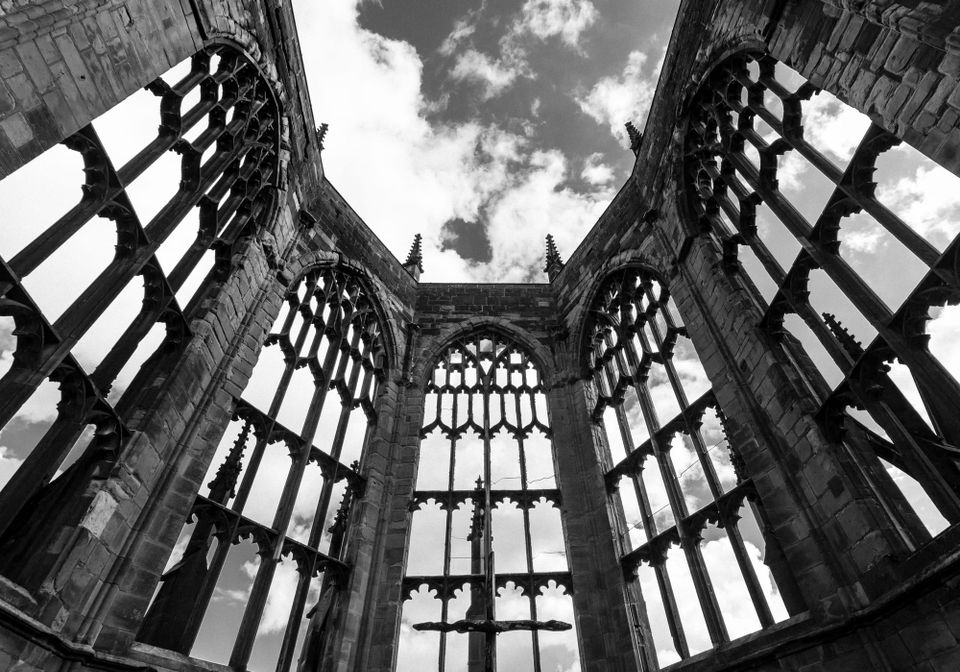
Resolution Plaza
Aisengard’s news media hailed the unveiling of Resolution Plaza as opening the gateway to reconstruction, heralding it as a symbol of Richtenstadt’s rise from the ashes and the beginnings of a glorious new regime. A steadily accumulating multitude pressed against a span of gold ribbon strung across the main entrance. Facing the crowd stood two grandiose arcades, held up by slender columns. Distinguished from earlier stone or masonry arches, Gerhardt built his from steel, giving them a lightness unknown before. The open arches atop the outer supports carried a continuous beam steel box girder clad with a frieze and a cornice. The composite entablature bound the outer colonnade across the top, implying an enclosure without an actual roof. Links between the inner and outer columns suggested cathedral vaults, stretching towards the exposed sky. For a hypostyle structure, it seemed impossibly airy.
A group of reporters and photographers encroached steadily through the crowds. City council members and other dignitaries pushed Gerhardt to the forefront of their formation. His first attempt to slip behind someone slightly taller than himself resulted in the others shuffling around him to place him prominently in the front row.
They’ll be more interested in interviewing the mayor and photographing the ribbon cutting ceremony than anything else.
The mayor stepped forward with a larger-than-life pair of scissors, holding it up as if he were giving a victory salute before making the cut. This time Gerhardt managed to step off to the side just before the cascade of shutter clicks. Since his experience in Francinia, he developed a phobia of cameras, as well as a strong aversion to appearing in the media.
Once the ribbon wafted to the stone pavers on either side of the mayor, members of the press corps surged through the portal that had just opened up, making way for the concentrated masses to roll in behind. Gerhardt receded towards the edge of the courtyard as people filtered around him, the mayor, and city council members. They poured into the square, zigzagging into the expanse like particles diffusing through a solution. They flowed under each of the arches that rose up at precisely defined intervals, through the colonnades and began accumulating around the large fountain in the center, some of them dipping their hands into the water. Others traced the edge of the design laid out in the stone courtyard as a stylized rosette, an abstracted compass reaching out from the fountain like spokes, tying the composition together. Gerhardt sensed an atmosphere of optimism from the crowd.
The plaza had to be carved out of a shallow hill and leveled to make the space. Even the retaining wall along the corner and one side wove perfectly balanced compositional elements into the plan. Only once people had spread through the expanse did Gerhardt begin to meander around it himself; it was the first time he had seen so many people in it. Though he tried to make himself as inconspicuous as possible, invariably, someone would flag him down to congratulate him on his war efforts or ask for his autograph. After several such encounters, he wondered if they realized he was the architect behind the design and not simply a token war celebrity hanging out as an embellishment to the occasion.
Finally, someone who wants to talk about architecture… He found himself explaining the geometric proportions to an interested bystander when he was approached by two others, one of whom wore the vestments of high clergy. Apparently the three of them had arrived together on a mission. After introducing themselves, the clergyman spoke. “I understand you’re also a structural engineer by training.”
“Yes sir.” Gerhardt wasn’t sure of the man’s position in the church or the proper form of address.
“How are you with stone masonry?”
“I’m familiar with structural and load bearing capabilities of both brick and stone. Depending on the kind of…”
“We would like to rebuild St. Augustine’s Cathedral using as much of the original materials as can be salvaged.”
Gerhardt responded reflexively. “Much of those ruins are structurally unsound, so it can’t be rebuilt completely using the old materials…”
The clergyman continued, “though we intend to keep the original plan, there will be some room to incorporate your own architectural expression… if you’re interested.”
“You mean… you want me…” to rebuild St. Augustine’s?
“You were highly recommended to us by your mentor and by the architectural guild.”
“Of course,” Gerhardt stammered. “I would be honored.” Which plan? It’s been expanded and partially rebuilt twice already.
“There is one thing, though,” the clergyman added in a somewhat more restrained tone. “You must bear in mind the ultimate purpose of this building; I don’t know your religious convictions, but… St. Augustine’s represents more than just a great architectural masterpiece that was lost during the war. Rebuilding it will go a long way to restore the confidence of the Teutonic people, but it is, first and foremost, a cathedral. You should view this as an opportunity to serve God above all else.”
In other words, you don’t want some brazen engineer flaunting his involvement for his own self-aggrandizement. “The scope and importance of St. Augustine’s is understood, and not just for its historical value.”
“Spoken like a true autocrat,” the clergyman smiled ironically. “…but not surprising considering your role in the war, Major Bosch.”
Oberst Leutnant… and I’m retired from the military anyway.
“I’ll not hold that against you since your actions were dictated by the necessity of a very cruel and brutal conflict. I just pray that we can quickly move past those… regrettable circumstances. You are obviously a hard-working and conscientious individual – and very earnest at that… Judging by the recommendations we’ve received,” the priest waved his hand at the space around him, “and from what we’ve seen here, we believe you will fill the role nicely. Hopefully in this endeavor you will realize something greater than yourself, and the experience may teach you some humility.”
I’m not sure how to take that…
Stasis
St. Augustine’s, while a relatively straightforward restoration, was not without its difficulties. The sheer number of resources that both the state and the archdiocese poured into the project allowed work to proceed at an accelerated pace. Richtenstadt’s government allocated considerable money on reconstructions that it deemed mattered most to the identity of the nation, and being appointed chief engineer was no mean task. Gerhardt tread lightly around rigid expectations held by some of the clerical hierarchy, presenting the structural constraints of the rebuilding as succinctly as he could without injecting a personal stake in the matter. For the duration of the project, he rented a room across the street with a window that looked out onto the site, immersing himself fully in the process. Since the war, the former ace hopped boarding houses and apartments, content with commuting by bicycle or walking to his destinations. Although he didn’t mind the lifestyle, he looked forward to a time when he might finally settle in one place and perhaps find someone with whom to fall in love.
Though acutely aware of the fact he was advancing past the age of available bachelor, that possibility still seemed distant, and he wondered if the war hadn’t precluded those prospects entirely. Whatever happened to Matilde? His efforts to reach her after the war turned up empty; perhaps she had moved away or found someone else. He wondered if he would ever see her again. At least for now he didn’t require much beyond basic comforts, spending most of his time either in his office or on site. Having also landed a few infrastructure contracts, he realized he would have to limit the scope of his endeavors while he was still working mostly alone. Nevertheless, his labors gave him a sense of purpose, refocusing his mind away from the war and the personal tribulation he suffered in its aftermath.
In his spare time, he revisited his portfolio of ideas. Rarely did he take days off but would occasionally go for long excursions, walking, cycling, or skiing vast distances. It was in these private sojourns that he imagined some of his most compelling visions.
Visions in the Mist
The Department of Civil Infrastructure resided in one of those large, previous-century stone masonry buildings with arched windows and doors compressed into form by heavy slabs. Like most of the older municipal buildings that had survived the war, this two-story construct had a large rectangular footprint with minimal structural embellishments other than a few pilasters. The gilded edifice that had once adorned it had been scoured away by the ravages of age and conflict. In its current configuration, the building projected the stolidness of a more formal era with its façade stripped bare. In contrast to its exterior, the building retained the elaborate paintings on the walls and ceilings of the lobby. These mainly depicted glorious battles from previous wars – wars for which the outcome had been more favorable.
Four men in suits, the committee for Infrastructural Advancement, greeted “Herr Bosch” as he entered the meeting hall on the first floor at the appointed time. The large conference room took up half the space on the main level, and the light stole through tall, narrow windows on the back wall, illuminating suspended particles of dust in regularly spaced straightedged lines, streaming buttresses of golden sunrays to the floor.
“Well…” the Director Engineer of both the committee and the institution began, “if it isn’t our illustrious flying ace. Sorry you met with such an unfortunate end.”
Gerhardt glanced around the room. “I’m still here.”
“Well, you know what I meant. It seems you have lofty ambitions as an engineer as well as a flying ace. Granted, your public works so far have been groundbreaking. One must admire your ingenuity on the redesign of St. Augustine’s – especially the speed at which it was accomplished, and your solution for the Low-Gate Community is quite elegant…” The Engineer Director leaned out over the table, “but now you want to build a twenty-one-kilometer bridge to cross the channel – at a proposed overall length more than seven times the current world record?”
“The concept is feasible.”
“…comprised of multiple cable-stayed spans? No large-scale bridge has been built on a completely stayed design.”
“The precedent is in the East River Bridge in New Metropolis in Vespuccia. That was originally begun as a suspension bridge before the designer added stays to reduce deflection of the deck...”
“Yes, I’m aware of it,” the elder engineer responded impatiently.
“I was planning to apply recent advancements in tensioning steel cables so that the stays carry the entire load. That way, we can do away with suspenders and the back spans and link several spans in series.”
“Son… I’ve reviewed your design… this hollow box girder deck you intend to cantilever out from each side of the supporting piers in counterbalance to one another. It all sounds miraculous on paper, but I don’t think you have a realistic idea of the resources it would take to do that.”
“The calculations are all on the drawings…”
Gerhardt’s interrogator responded, “yes, I see you’ve estimated your material and labor requirements… but where do you plan to get all this steel? Who is going to use this bridge in the first place? Who is going to pay for it, let alone build it?”
“It would cut transportation times to a third and increase volume by…”
“You… of all people… have borne the wrath of our Francinian enemies more than anyone – why now, would you want to build a bridge to them?”
“It would make crossing a lot simpler. Think what that would do for logistics and trade.”
The Director Engineer shook his head. “If this is your answer to Devonia’s blockade, it’s a little late for that now.”
“The war is over,” Gerhardt responded pointedly.
“Well, I’m afraid the world isn’t ready to construct your rainbow bridge across the channel any more than it was to embrace the power of the flying machine as you envisioned it.”
“Someone will eventually do it.” Gerhardt responded coolly.
He experienced an instant flashback to some of his encounters with the Grossadmiral when the Director Engineer banged his fist emphatically on the table. “I tell you what young man… when you can reduce the projected costs of your bridge to one third, convince the Francinians to pay for half of it, and redesign it to use one tenth of the steel that your current proposal calls for, then we might take it seriously. Until then, we have nothing further to discuss.”
“Very well,” Gerhardt responded, just as if he had been speaking with the Grossadmiral. The only difference now was he was operating in the civilian world, so he didn’t wait for a dismissal but turned around and walked away, gently closing the massive double oak doors behind him.
The murmurings of the committee followed him out of the room, including the Director Engineer’s, not so muffled remark, “can you believe the arrogance of that kid?”
“Just wait,” another voice chimed in, “he’ll probably try to do it, too.”
Damn straight I will… Their comments rolled off Gerhardt, as his mind had already begun calculating his options.
Pilgrimage
The Federal Technical Institute of Richtenstadt, located in the city of Strassenburg high up in the mountains had become one of the most renowned civil engineering schools in the world within a half-century of its founding. For the first time since the war, Gerhardt ventured into the Valhalla range, though the two-day trip was anything but straightforward. A bus ride, followed by a train ride to the base of the mountains, then a transfer to an overnight train that crawled through the treacherous passes at a pace slower than he could ride his bicycle brought him to the outskirts of town, where he made the last eighteen kilometers of the journey on skis. A telegraph-cable from the institute vaguely assured him that his intended contact was indeed still affiliated with the university and could probably be found working on a new triple arch bridge downtown.
The source of the Nivalon River originated from the confluence of branches flowing from large glacial lakes nestled in the mountain peaks above, but by the time the body of water converged and reached the town, it had widened significantly, necessitating a means of passage between banks separated by a deep, and sometimes raging river. Stone and wooden bridges had to be continuously rebuilt through the ages as floods and avalanches washed them out, and each time, the builders would strive to come up with some new design more impervious than the ones that preceded it. Even now, the river was high, but near the center of town, two towering concrete arches of the partially completed bridge rose up over twice the height of previous structures, creating a more open channel and promising greater longevity than lesser bridges might afford in such a harsh environment.
Once at the edge of the construction site, Gerhardt took off his skis and set them sticking up crisscross in the snow, along with his poles near an ancient wooden piling that had long since rotted through. Around it sagged a haphazard meshwork of deformed wire and fallen-down boards that had either shifted due to erosion or been trampled – or both. The makeshift barrier offered numerous gaping holes through which pedestrians and wild animals could, and apparently did, frequently pass. It was through one of these that Gerhardt slipped onto the site. From the top side, he had an unobstructed view of the entire construction zone. A system of temporary overhead cables ferried materials across the river, but the massive twin arches dominated the view as the spandrels and the deck had yet to be added.
Indentions in freshly fallen snow pointed to recent traversals along the crest of the embankment, and Gerhardt searched for hints of a path that could lead him to the site below. Venturing to the edge, he lost his footing, skidding several meters down a steep snow-covered grade, nearly glissading on his seat towards a group of men working below.
His attempt to self-arrest resulted in a gradual stop with piles of snow plowed up between his sides and outstretched arms. He stood up again and aimed himself towards one of the crew chiefs in a bright green construction helmet. “Endshuldigung,” he called out, “do you know where I could find a Herr Heinrich Bonhoffer?”
“Sir, you can’t be in the construction site, only authorized personnel can be inside the fence!”
Gerhardt glanced at the path he just descended, wondering how he would climb back up since it was apparent that he wouldn’t be allowed to walk through the construction zone. “All right, I’ll come around to the gate.” He started trying unsuccessfully to claw his way back up the grade but realized his mistake only after slipping down to his previous position on several attempts. His efforts had only managed to churn up the white blanket of snow into brownish sludge. “It’s muddy up here,” he commented, feeling silly for his underestimation of the terrain. Directing his gaze back towards the group below, he elaborated on his previous thought. “Do you know where I might find him? I’ve travelled all the way from Aisengard and I’d really like to speak with him.” He tried once more to ascend, but seeing he couldn’t get any traction, finally acquiesced to the terrain, “seems I can’t get back up.” His only option was to let himself down in a controlled slide the rest of the way to the bottom and pick his way across some icy mush to stand near the shore where the construction crew was sorting wooden pieces to assemble as falsework over which to build the superstructure.
“Look, since you insist on coming through here, you’re not supposed to be in the area without a hard hat,” the crew chief barked from the other side of the scaffolding.
“Very well,” Gerhardt said before producing one out of his backpack and plopping it on his head over his wool toboggan with the earflaps pulled down. The helmet’s light blue color immediately identified him as someone involved in architecture, construction engineering, design and planning. He threw his backpack over one shoulder and started towards the site entrance almost as soon as he touched solid level ground. It was from here that the giant reusable wooden framework supporting the second arch while the concrete set became visible.
“I’ll just…” he thumbed in the direction of the gate, before interrupting himself, “What measures are you applying to control for creep?” He threw a glance towards the wooden centering holding up the second arch. “Might one arrange a site visit when you start pouring again?”
“Gerhardt Bosch?”
Gerhardt blinked back his surprise. With his scarf and hat covering most of his head and neck, and his anorak collar pulled up, he would have scarcely thought anyone would recognize him. Then again, being a man of his age, an engineer from Aisengard, and still sporting that old-fashioned mustache, fastidiously trimmed so that it stopped where it framed the edge of his mouth, might have narrowed the possibilities quite a bit. “I read his work on reinforced concrete as well as his thesis on prestressing, and I was interested in studying the techniques, maybe collaborating on some projects...”
“Damn… ” the crew chief murmured. “You sure know how to make an entrance.” By now everyone else had stopped working and turned his head in the newcomer’s direction.
Gerhardt felt himself redden at his rather awkward intrusion. He seemed to have perfected the knack for dropping out of the sky. “I don’t want to interrupt your work, perhaps I could arrange a time to come back later.”
“Last I saw Herr Bonhoffer, he was in the office.” The crew chief pointed over to a makeshift shack near the foot of the first arch. “You can probably find him in there.”
“Dankeshön,” Gerhardt responded before moseying in that direction.
A clean-shaven man of about his age with close cut hair looked up from his desk as soon as Gerhardt opened the door, then locked gazes with him. “Hmmmph.”
Gerhardt tilted his head, noting the man’s bearing suggested military experience. The thinness of his face and high-vaulted dome topped off by tightly cropped wisps of hair gave the overall impression of a matchstick. “Herr Bonhoffer?”
“What can I do for you, Herr Bosch?”
It’s got to be the stupid mustache… “I’m interested in your advancements in concrete reinforcing, especially your thesis on prestressing, and I would like to investigate the techniques further. Perhaps you would be amenable to collaborating on a few projects.”
“What do you have in mind?”
Gerhardt unshouldered his pack and retrieved a tube he had stuck down in it, pulling several design sketches out of it. “Ultimately, I want to build a bridge across the channel – the first iteration was designed primarily of steel, incorporating tensioned cable stays – but I think use of reinforced concrete for the pylons and towers, and pre-stressed members in the approach decks could greatly reduce cost and materials. I had an idea to develop a concrete hollow box girder and was hoping to try the concept on a shorter prototype where we could make field observations and test some of your theories.”
Herr Bonhoffer took several moments to study the sketches before speaking. “Impressive drawings, Herr Bosch… quite impressive… but if I may say so, I too come from a military background, having attended the military lyceum and later the Armed Services Academy. I spent the war as a military engineer, and if I had challenged High Command the way you did, even once, let alone multiple times… my career would have abruptly ended.”
Gerhardt responded, “I never intended to challenge High Command, but someone in the field needed to try something different, even if it went against accepted conventions.”
“I’m sorry, but I don’t agree with you. In matters of warfare, we cannot allow every field officer to start sidestepping the chain of command.”
“If you had discovered a flaw during construction in one of the army’s projects that you knew would lead to catastrophic failure, wouldn’t you point it out before allowing work to continue – even if your commanding officer didn’t agree with you?”
“That’s a different matter. Assuring structural integrity was my job. No one would have called my judgement into question.”
“Then why should they question mine for the way I conducted aerial warfare?”
“Your actions went well beyond the scope of aerial warfare and skirted the boundaries of your authority. Forgive my saying so, but you were not the Grand Marshal or the Grossadmiral.”
“Adjusting for flaws in strategy is not overstepping authority, especially once it became clear we hadn’t planned logistics well enough to support our offensives.”
“It was not your job to fix our strategy. Yours was not the only solution to the blockade, and perhaps you presumed too much by pressing forward with it on your own.”
“What was I supposed to do, let our forward units starve from lack of provisions while our leaders argued over doctrine? I was frustrated by the lack of response...”
“Weren’t we all? You could have waited it out and let the admirals and generals take collective responsibility for their mistakes, but once you took it upon yourself to correct the problem, you not only derailed our entire long-term strategy, but completely changed Devonia’s political dynamic. When you did that, you assumed direct accountability for the outcome of the war… but I’m sure you understood that at the time.”
Though Gerhardt had heard the arguments before, the way Bonhoffer presented them suddenly clarified some of the sentiments expressed on both sides that Gerhardt himself had not previously grasped. He furrowed his brows. “Who could have known at the time what the overreaching effects would be? Post-war analyses and their future interpretations never crossed my mind, nor had I anticipated Admiral von Kreuzen’s opposition.”
“Well, you took a gamble that didn’t pay off. I’m not implying anything would have turned out differently if you hadn’t because I don’t know, but you shifted the burden squarely onto your own shoulders when you did.”
Gerhardt recalled his professor’s admonition not to take the defeat of an entire nation upon himself. Looks like everyone else expects me to do it. He shrugged off his lack of immediate rebuttal, then added, “your point is taken, but I’m not sure what the relevance of it is to the proposal at hand.”
“Since you show up on my construction site and come barging into my office unannounced, I figured you wouldn’t mind if I ask you some of the questions that have been burning in the back of a lot of people’s minds since the war.”
“…not completely unannounced, I did send a cable...”
“Well, most of us aren’t used to such… unconventional procedures.”
“Does that mean your answer is ‘no’?”
“I didn’t say that…”
Steel and Concrete
A regular exchange of letters and telephone calls between the two engineers ensued over the next six months. Gerhardt went back to the city in the mountains three more times during the spring and early summer to observe completion of the falsework, continuation of the structure itself, and visit Bonhoffer’s university lab. By late summer, with the triple arch close to completion, Bonhoffer found the time to make the reverse visit.
Gerhardt picked out Bonhoffer’s silhouette on the street the moment he saw it through the coffee shop window. The civil engineer’s uncertainty immediately identified him as an outsider in the capital. Gerhardt followed his movements as the visitor glanced around a few more times to find his destination and opened the door, scanning the space inside for his contact. Gerhardt, who had been watching him the entire time, raised his hand so that his counterpart could find him in the crowd. As host, he offered, “can I buy you something to drink?”
“Oh sure, just a coffee would be fine.”
“How was your trip across the mountains?”
“It was good,” he responded unconvincingly, “but, trying to coax a three-year-old to sleep on an overnight train is a task next to impossible.”
“When did you get in?”
“We came in yesterday morning. The hotel we found is more than I expected, and we’ve already had a chance to see a few sites, including the Plaza and St. Augustine’s. I had the pleasure of attending the dedication recital of the new Johann Müller organ last night.”
“Oh, how was it? I hear it has incredible depth of sound.”
“It was superb – both the program and the instrument – and I have to credit you with the acoustics. They’re phenomenal.”
“Preservation of the acoustics was one of the requisites for the new design. You know, they started working on that organ as soon as I gave them the blueprints for the church.”
“Really, that long?”
“Ja, they built the whole thing off-site and stayed in correspondence with me throughout the entire process to make sure their dimensions would fit the space. Then it took them almost a year to install it and voice the pipes. I saw parts of it going in; the cabinet work is exquisite. The construction start-to-finish took longer than the cathedral restoration itself.”
“It’s a fitting addition to the space. I don’t know what the acoustics were like before, but from what I understand, they’re better now than in the original church.” A faint furrow crept across Bonhoffer’s brow. “I looked for you during the intermission; I was surprised I didn’t see you there.”
Gerhardt shrugged. “I couldn’t make it.”
“At least you live here so you can go whenever you want. While we’re in town, my family and I are planning to attend the service this Sonntag. Perhaps you would like to join us.”
Gerhardt narrowed his eyes. After a thoughtful pause, he released a breath. “I would probably be asked to leave.”
This time Bonhoffer raised a brow in response.
Gerhardt answered his unspoken question. “There are those in ecclesiastic circles who have taken a distinct dislike to me.”
“What, over some contracting issues?”
“No, a few assumed when we rebuilt the cathedral, we could just stack everything back the way it was. I couldn’t make them understand the degree of deterioration or the fact that, even before it had been bombed out, the walls had started to pull away from the vaults and would do so again if we rebuilt it exactly as before.”
“You’d think they’d be willing to accept your advice since they hired you.”
“Apparently, they found my manner… too abrasive.”
Bonhoffer knitted his brows again. “Listen, I’m sorry for being so forward when you first sought me out. No one from the department notified me you’d sent the cable, so I had no idea you were coming.”
“I don’t think whoever read it took my request seriously.”
“Again, I’m sorry. It wasn’t handled correctly, and needless to say, when you showed up unexpectedly, I just assumed you were grandstanding the way you were notorious for doing during the war.”
“I never liked being cavalier, but apparently, I can still come across that way. Post-war notoriety is something I’ve not managed to escape.”
“Speaking of which, this is the first time I’ve seen you without a scarf.” Bonhoffer nodded towards the chain without making specific mention of it.
“This is the first time we’ve met indoors during the summer.”
“I’m surprised you don’t…”
“Everyone knows about it, so what would be the point of hiding it?”
Bonhoffer shrugged, “have you ever thought about getting rid of it?”
“Sure, all the time, but it would be a bigger risk than it’s worth. Maybe in the future there will be an easy way to do it, but for now, it’s not causing any problems, and I have other things to think about.”
“I would think it would annoy the hell out of you after a while.”
“Dredging up that experience annoys the hell out of me.”
Bonhoffer’s face flushed briefly as he took the cue.
Gerhardt nudged the conversation back on course. “While you’re here, I was hoping you could help set up a prestressing lab like the one you’ve built in Strassenburg. I occasionally put in a bid for civil contracts, and I just submitted a design for the proposed 800-meter span Nord River Bridge. All the others I’ve seen so far are traditional suspension bridges. Mine is a cable-stayed design with a single main span and a prestressed concrete deck, something of a prototype for the Channel Bridge on a smaller scale.”
“Yes, I looked at the drawings you sent me. I liked them – ambitious, and iconic.”
“I’ve done an alternative variant in steel – I’m especially concerned about the deck design – but I’m banking on being able to hire you as a consultant.”
“I’d be happy to collaborate with you on this project and on the Channel Bridge if it gets approved, but I seriously doubt you’ll be able to secure the funding for the latter.”
“Maybe one day we can convince enough investors it would be worthwhile, especially if we’re able to demonstrate with a prototype how efficiently it could be built.”
“I wanted to ask – that steel, three-hinge arch near the Low Gate – that’s one of yours, isn’t it?”
“Ja,” Gerhardt nodded.
“I couldn’t help but notice how reminiscent it is of St. Augustine’s interior and Resolution Plaza – quite striking – and so much more graceful than those heavy trusses down near the big shipping ports.”
“The three-hinge approach worked out well for automotive traffic in a residential area. We had to build it on extremely shallow excavations due to the low rise of the embankment yet make it tall enough for small boat traffic. We built in enough clearance for a 28-meter main mast. A through truss would have worked just as well, but it would have been more expensive and, in my opinion, far less aesthetically satisfying.”
“Very nice solution.”
“Thank you… but while you’re here, I’d recommend staying away from the ports. You’ll not find a more dismal nest of hooliganism than the docks. It’s a dangerous place for tourists. I don’t even like going there myself.” Dietrich’s and his not-so-excellent adventure replayed itself in his mind. “It’s certainly no place to take a three-year-old.”
“I’ll keep that in mind, thanks for the heads-up. I’m curious though, what are your plans moving forward in business? You seem divided between architecture and engineering.”
Gerhardt leaned back in his seat. “Other than renovation work and a few infrastructure projects, I’ve designed a few mid-size commercial and municipal buildings. I’ve got the contract to design the new Capitol Building and that’s been keeping me occupied for a while. I also have a preliminary proposal for a skyscraper. The problem is I’m the only structural engineer in what’s still a relatively small firm. The direction we go will depend on whom I can hire and what kind of talent I can bring on board. I don’t mind training up new people, but I could use more engineers – especially well-trained ones… and we could really use a good site planner.” Gerhardt hesitated in his speech. “What after your tenure at the Institute? Are you planning to stay on there, or are you considering moving to Aisengard?”
Bonhoffer’s eyes narrowed as he considered the implication. The suddenness of the implicit offer seemed to present a conundrum. “I would be willing to help you set up a prestress lab and to compare notes. In fact, I think it would be great validation if we can duplicate each other’s research independently. I could also consult with you on site planning, but at this time I’d be hesitant to leave the Institute. I’ve got a good position, a lot of funding, and a number of projects to finish up in Strassenburg. I don’t think my family is quite ready to pull up our roots either. However,” he interrupted himself emphatically, “I do have some promising students who will be looking for apprenticeships.”
“I would be happy to have them.”
“I’ll send some your way, and I look forward to our continuing collaboration.”
The Industrialist
The old factory that Gerhardt found to set up a prestress lab happened to be located just far enough outside the dock district that he didn’t feel as though he were endangering Bonhoffer, and he didn’t mind working there alone. Though the abandoned warehouses near the ports would have been cheaper to rent, Gerhardt had learned through experience that some things were not worth the risk.
Earlier that morning, he, Bonhoffer, and two engineering students brought in some of the equipment Gerhardt would need to duplicate Bonhoffer’s work, including some smaller hydraulic jacks, bars and cables of varying grades of steel, and several spools of multistranded steel wire. After the move-in, his colleagues departed for Strassenburg, leaving him to his own devices. While he would not attempt some of the more hazardous tests alone, he could get started organizing his workspace and designing his first experiments.
The sun streamed in from the clerestory, raining down a shower of light. The weather turned out to be uncharacteristically warm this late in fall, and it made everything feel full of promise; in his new lab, Gerhardt sensed endless possibility for ingenuity, and the potential for a positive future. He wrestled with a hydraulic jack to rearrange it on one of the workbenches before he remembered that it took him, Bonhoffer, and both of the students considerable effort just to get it where it was. Once off the dolly, the thing was slick and awkward to handle. He would wait to move it when a proper chain hoist arrived with the next batch of equipment.
A rapid knocking interrupted his efforts. Is someone at the door? I wonder if Bonhoffer forgot something.
“Who is it?” he called out. No answer. Whoever it was probably couldn’t hear him from the street.
Who in the world would come calling here – unless it’s a solicitor? Last thing I need is someone trying to sell me a vacuum cleaner.
Not sure what to expect, Gerhardt opened the door to find a small-statured gentleman about his father’s age in a tailored gray waistcoat and white shirt banded with garters on the sleeves, probably to keep his gold cufflinks off the backs of his hands and out of the way while he worked. Gerhardt noticed them immediately. They seemed incongruous with the callouses on the wearer’s hands.
“May I help you?” Gerhardt queried tentatively. He thought perhaps the chap had gotten lost in this part of town and was looking for an address. Despite the warmer than usual weather, it would have been almost unthinkable not to wear a suit coat in an office setting, so Gerhardt surmised perhaps the visitor worked as a high-ranking clerk or supervisor in a nearby factory. On second inspection, he noted the man’s shoes and clothing proclaimed him to be of the well-to-do class. Even more surprising was that the man walked right inside as though it had been his own apartment.
Entshuldigung? Gerhardt blinked as he pulled his head back followed by the rest of his body, but the intruder seemed not to notice the inconvenience he caused and surveyed the space around him, momentarily sweeping his glance across his host. That’s when Gerhardt noticed the man’s eyes had the most incredible gemstone quality he had ever seen. “How may I help you?” he repeated.
“I like to check in with our new tenants to make certain everything is satisfactory. I trust the space meets your expectations.”
“Oh, so you’re with the property management agency.”
“Our company owns these holdings, and the management agency is one of our subsidiaries.”
“Ah, I see. Well, I don’t mean to… uh, sound curt, but it might be a bit dangerous in here.”
“I see you’re experimenting with reinforced concrete…” He drifted over to where the hydraulic jack sat that Gerhardt had attempted to move before his arrival. “I suppose prestressing can be a dangerous occupation. Looks like you’re attempting to duplicate Herr Bonhoffer’s work from the Federal Polytechnic.”
“How do you know about that?” The thought flashed through Gerhardt’s mind that this guy might be an industrial spy.
“I do keep up with the literature.” The man stopped his movement long enough to glance down at a schematic that Gerhardt had left out on the table. “Hmmm… you’re already entertaining the possibility of post tensioning the steel tendons after the concrete form is made… anticipating less than 15% loss in pre-stress. I see you intend to apply the technique for joining segments of your hollow box girders into larger spans.” The man’s aquamarine eyes drifted up to meet Gerhardt’s. They locked with his to hold his gaze squarely. Their intensity took Gerhardt aback. There was something stark, cold in the man’s stare, but Gerhardt couldn’t formulate what it was. Fortunately, the man broke off his gaze, letting it drift back to the schematic. He commented casually, “an idea a decade or two ahead of its time, really.”
“Are you an engineer?”
“Metallurgist by training. Of course, the length of your box girders will be limited by the strength of the current steel alloys and the power of your hydraulic jacks.” Gerhardt took note of the fact that the man spoke with impeccable pronunciation in the Hoch dialect, but with an uncharacteristic elongation on certain syllables, and an entirely different melody from the Teutonic language. Gerhardt couldn’t tell immediately if he were a foreigner, or if the accent were some sort of affectation. The man offered, “perhaps that’s something I can help you with.”
“So… you are soliciting,” Gerhardt half laughed. The words came reflexively out of his mouth before he had even thought about what he said.
“I think there exists a great potential for collaboration between us, Herr Bosch. I can certainly provide better jacks than the ones on loan to you from the Federal Polytechnic.” Gerhardt attempted to push the jack a few centimeters further to the center of the workbench. Eventually, he would move it to another area, but for the time being, he just wanted to shield his research from this man’s prying. “Let me help you with that,” the self-proclaimed metallurgist offered, but before Gerhardt could admonish him how heavy it was, he had already lifted it off the bench and transferred it to another where Gerhardt had originally planned to move it. How the hell did he do that?
“I could probably loan you a gantry before your hoist arrives, and I suppose I could sell you a vacuum cleaner. Our company does produce several shop models…” The intruder ran his index finger along the edge of the workbench where he had just set down the heavy piece of equipment, collecting a fair amount of dust on his fingertip. “…and judging by your workspace, it looks like you could use one.”
Who the hell did this guy think he was, anyway, to come barging into Gerhardt’s laboratory? Gerhardt could barely contain his anger at the man’s presumption. The sharpness of his tone demanded, “…and your name is?”
“Mazeppa, Georgy Volodyrmyrovych.” He offered his hand. It felt freezing to the touch, and more powerful than that of a man twice his size. What he lacked in stature, he more than made up for in sinewy strength. Sizing him up again, Gerhardt could tell that, despite his manner of dress, this man carried none of the softness of the aristocracy and his features seemed as hard, and unrelenting as the steelwork in the lab.
“Georgy Mazeppa… head of Mazeppa Heavy Industries?”
“The same,” he nodded cordially. At least that explained the man’s expertise, and partially allayed Gerhardt’s fears that he might be an industrial spy. His second thought was that he had better attempt to be affable towards one of the major innovators in an industry that touched every aspect of his trade. He also reminded himself of the fact that the company that bore this man’s name pioneered rezenium alloy. He shuddered at the thought that the person so casually conversing with him at that moment may have had a hand in its discovery. It made him acutely aware of the fact that he wasn’t wearing a scarf. Even if the weather had been cold, loose clothing would not have been appropriate in a lab setting like this. As if picking up on Gerhardt’s unease, the man’s glacial stare settled on him at the base of his neck where the chain rested on his collarbones. “The technology doesn’t yet exist to remove that chain safely, but it is only a matter of time before it will. One day you’ll be able to cast it off, if you so choose.”
Gerhardt felt his eyes narrow at the man. He didn’t say anything, but he could not mask his ire at the straightforward-to-the-point-of-being-insensitive way in which Mazeppa broached the issue. The fact notwithstanding that Mazeppa was his landlord, he wanted nothing more than to throw him out.
“As I say, I believe we could forge… a very productive partnership.” Mazeppa gave his head a faint tilt, apparently picking up the hint that he had worn out his welcome. He drifted back towards the door and paused a moment before making his exit. “Do give my offer some consideration.”
Member discussion